The Patterson Arts Method
A Complete Musician. An Individual Voice.
After more than twenty-five years of teaching, I hold one conviction above the rest: technique matters most when it gives a person greater freedom to communicate. Everything in this Studio is built to serve that freedom — and to bring out the voice that is already in the student, not to stamp mine over it.
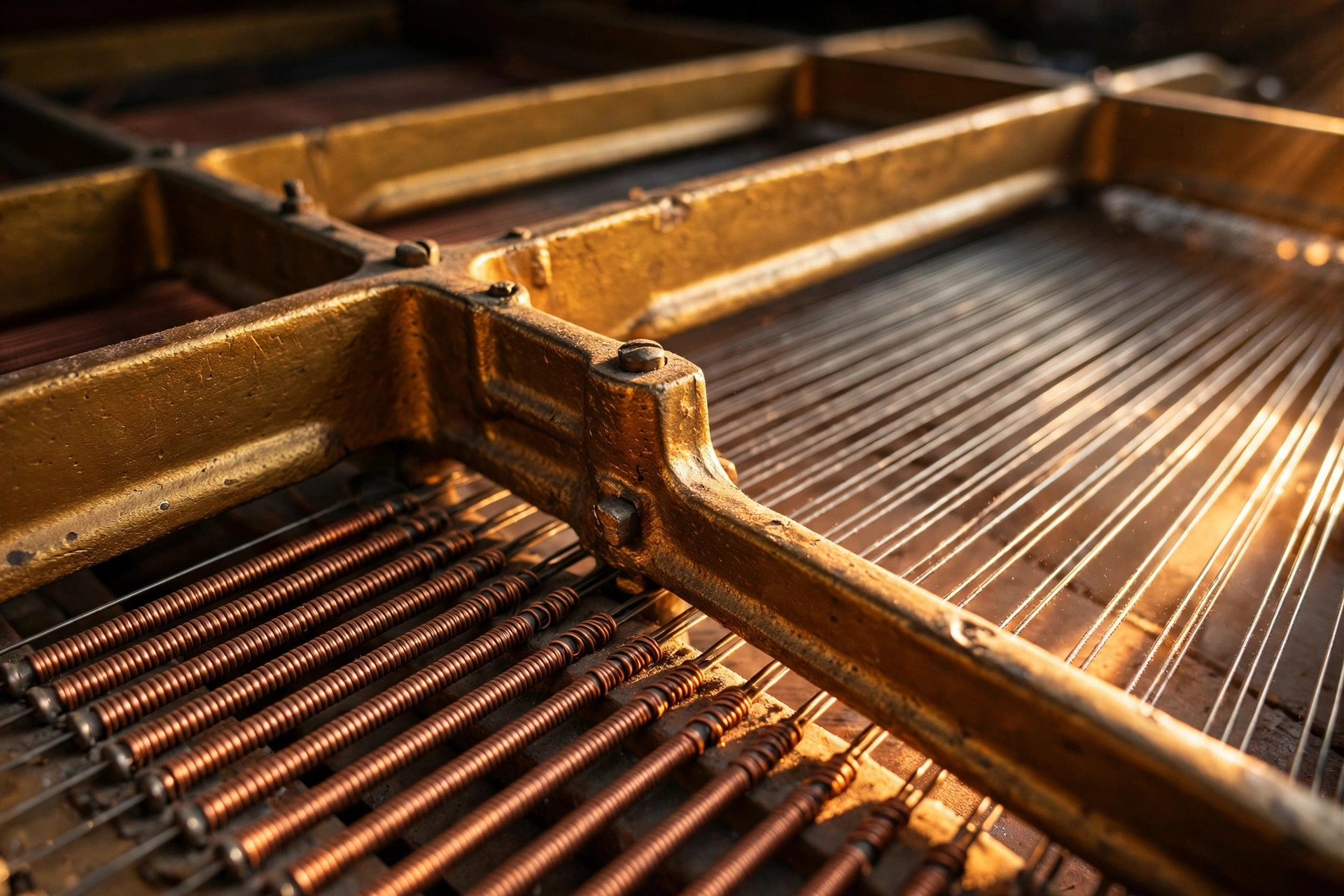
Inside the instrument — a golden frame, steel and copper-wound strings. Photographic plate from the Studio's own collection.
The method in one breath: students here encounter a sound-before-sight approach, in which listening, imagination, theory, movement, and expression become one coherent path. The ear leads. The page follows. Four pillars carry the work.
Technical Freedom
Build coordination, balance and physical ease so technique serves expression. A body at ease at the instrument is not a luxury; it is where phrasing begins.
Musical Understanding
Connect the ear, the score and the musical story through theory, aural work, history and composition. A student who understands what the music is doing can say something with it.
Purposeful Practice
Know what to listen for, what to change and how to make each practice session count. Practice is not repetition; it is a series of small, deliberate decisions.
Performance Artistry
Learn to communicate with conviction, prepare thoughtfully and carry your musical voice onto the stage. The stage is not a test to survive; it is the reason for the work.
Why sound before sight?
Because music is heard before it is read. When a student learns to hear a phrase — to imagine its shape, its breath, its destination — the notation becomes a map of something they already know, instead of a code they are still decoding while they play. Listening, imagination, theory, movement, and expression stop being five separate subjects and become one path. That coherence is what turns years of lessons into musicianship.
What does "an individual voice" protect?
Two students can play the same Chopin nocturne correctly and say entirely different true things with it. A conservatory education that produces only correctness has done half its job. The other half is helping each musician find what their playing is for — the sound they are drawn to, the stories they need to tell — and giving them the technique, the understanding, and the stagecraft to say it in public, with conviction.
That is the standard I was formed by, and the one I teach by: at a masterclass level for those who are ready, and — this matters just as much — at whatever pace genuinely serves the person in front of me. Virtuosity, here, is not a tempo. It is the distance between what you hear inside and what your hands can say.
Study at the Studio
Personal piano and voice study in St. Augustine and live online, worldwide: private study, theory and aural training, composition, and invited masterclasses — with lessons and masterclasses on Steinway Model D concert grands. Placement begins with a conversation and a careful review, so the plan fits the musician, not the catalogue.
Begin with a placement review · Explore the Studio · More from the blog